Why Does My Perfume Fade After One Hour?
You spritz your favorite perfume in the morning, feel amazing for about 20 minutes, and then… nothing. The scent seems to vanish into thin air. You lean into your wrist, sniff hard, and barely catch a whisper of what was once a bold, beautiful fragrance. Sound familiar?
You are not alone. Thousands of perfume lovers deal with this exact frustration every single day. They spend good money on a bottle, expect it to last from morning to evening, and end up reapplying three or four times before lunch.
The good news? Once you understand why your fragrance disappears so quickly, you can take simple steps to fix it.
This post breaks down the real science behind perfume fading and gives you 12 actionable solutions that can double or even triple how long your scent lasts on your skin.
In a Nutshell
- Your skin type matters more than you think. Dry skin lacks the natural oils needed to hold fragrance molecules. Oily skin grips scent far longer. If your skin runs dry, moisturizing before application is one of the easiest and most effective fixes.
- Fragrance concentration determines longevity. An eau de toilette (EDT) contains only 5% to 15% fragrance oils, while an eau de parfum (EDP) contains 15% to 20%. A higher oil concentration means a longer lasting scent, often by several hours.
- You might be nose blind, not scentless. A phenomenon called olfactory fatigue makes your brain stop registering a scent you have been exposed to for a while. Your perfume may still be noticeable to others even when you think it has vanished.
- Application technique changes everything. Spraying on pulse points, avoiding rubbing your wrists together, and applying after a shower can all extend your fragrance life significantly.
- Storage conditions can quietly ruin your perfume. Heat, light, and humidity break down fragrance molecules over time. A bottle stored on a sunny bathroom shelf will lose its potency much faster than one kept in a cool, dark drawer.
- Layering is the most underrated trick. Using a matching body wash, lotion, and perfume creates multiple scent layers on your skin. This gives the fragrance more staying power throughout the day.
Understanding How Perfume Works on Your Skin
Perfume is made up of three layers of scent called top notes, heart notes, and base notes. Top notes are the first thing you smell after spraying. They are usually light, fresh, and citrusy. These molecules are small and evaporate within 15 to 30 minutes.
Heart notes appear next. They form the core of the fragrance and last about two to four hours. Common heart notes include florals like rose, jasmine, and lavender. They give the perfume its main character.
Base notes are what stick around the longest. These are heavy molecules like vanilla, musk, sandalwood, and amber. They can last six hours or more. If your perfume seems to fade after one hour, it is likely built around lighter top and heart notes without a strong base to anchor it.
Your skin acts as the delivery system for these molecules. When you spray perfume on your skin, the warmth of your body helps the fragrance diffuse into the air around you. But the condition of your skin determines how well those molecules stay attached. Skin that is well hydrated holds onto fragrance far better than skin that is dry and flaky.
The pH level of your skin also plays a role. Each person has a slightly different skin chemistry, which is why the same perfume can smell different on two people. Some skin types actually break down certain fragrance molecules faster than others.
Why Dry Skin Makes Perfume Disappear Faster
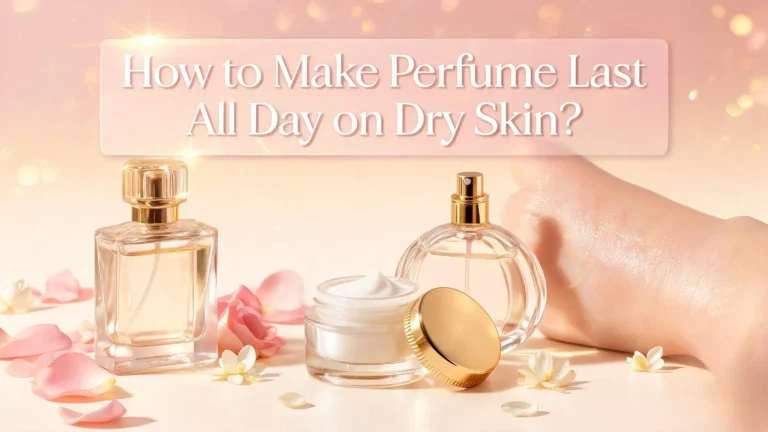
Dry skin is the number one reason perfume fades quickly on many people. Fragrance molecules need something to cling to. On oily skin, natural sebum acts like a sticky surface that traps and holds those molecules close. On dry skin, there is very little oil to anchor the scent, so it evaporates rapidly into the air.
Think of it this way. Spraying perfume on dry skin is like pouring water on sand. It absorbs and vanishes almost immediately. Spraying on moisturized or oily skin is more like pouring water on a smooth, slightly oily surface. The liquid sits there longer.
If you have naturally dry skin, you will almost always notice shorter fragrance wear time. This is especially true in winter months when cold air and indoor heating strip moisture from your skin even faster. People with dry skin often report their perfume lasting only one to two hours, while those with oily skin enjoy four to six hours from the same bottle.
The fix is straightforward. Apply an unscented moisturizer or body lotion to your skin right before you spray your perfume. The moisturizer creates a hydrated layer that gives fragrance molecules something to bind to. This one simple step can add hours to your perfume’s life.
Pros: Cheap, easy to do, works with any fragrance.
Cons: Adds an extra step to your morning routine; scented moisturizers may clash with your perfume.
The Petroleum Jelly Trick That Actually Works
One of the most popular fragrance hacks on social media right now is the Vaseline trick, and there is real logic behind it. Petroleum jelly creates a thick, occlusive layer on your skin that seals in moisture and gives fragrance molecules an excellent surface to cling to.
The method is simple. Take a small amount of unscented petroleum jelly and dab it on your pulse points: wrists, neck, behind your ears, and inner elbows. Then spray your perfume directly over those spots. The jelly acts as a barrier that slows down evaporation, keeping the scent close to your skin for much longer.
Dermatologists confirm that petroleum jelly locks in moisture by creating a physical seal on the skin’s surface. Since hydrated skin holds fragrance better, this barrier effect can noticeably extend your perfume’s wear time. Many users report their scent lasting two to three times longer with this method.
You do not need to use a lot. A thin, almost invisible layer is enough. Too much can feel greasy and may actually dilute the scent if applied too heavily.
Pros: Very affordable, widely available, easy to apply, significant improvement in longevity.
Cons: Can feel greasy on some skin types; may slightly alter the fragrance opening; not ideal under makeup.
Fragrance Concentration: Are You Buying the Wrong Type?
Not all perfumes are created equal. The concentration of fragrance oils in your bottle has a direct impact on how long the scent lasts. Many people buy an eau de toilette without realizing it is formulated to be lighter and shorter lived.
Here is a quick breakdown. Eau de Cologne contains 2% to 4% fragrance oils and lasts about two hours. Eau de Toilette (EDT) contains 5% to 15% and lasts roughly three to five hours. Eau de Parfum (EDP) contains 15% to 20% and lasts four to eight hours. Pure Parfum or Extrait contains 20% to 40% and can last eight hours or more.
If your perfume fades within an hour, check the label. You might be wearing an eau de toilette or even an eau de cologne. Switching to the eau de parfum or extrait version of the same fragrance can make a dramatic difference in how long it stays on your skin.
The tradeoff is cost. Higher concentration perfumes typically cost more per bottle. But because you need fewer sprays and reapply less often, a single bottle can actually last longer overall.
Pros: Most effective way to guarantee longer lasting scent; no extra steps required.
Cons: Higher upfront cost; stronger concentration may feel overwhelming to those who prefer light scents.
You Might Not Have Lost Your Scent: Olfactory Fatigue Explained
Here is something that surprises many people. Your perfume might still be going strong, but your nose has stopped detecting it. This is called olfactory fatigue, also known as nose blindness, and it is a completely normal biological response.
Your brain is wired to prioritize new sensory information. When you are exposed to the same smell for an extended period, your olfactory receptors stop sending signals about that scent to your brain. Your nervous system essentially decides the smell is not important anymore and filters it out so you can focus on detecting new or potentially dangerous smells.
This can happen within 15 to 30 minutes of applying your perfume. You stop smelling it and assume it has faded. Meanwhile, the person sitting next to you at work can smell it clearly. This is why friends or coworkers sometimes compliment your perfume hours after you thought it had vanished.
A simple test: ask someone near you if they can still detect your fragrance. You might be pleasantly surprised. Another method is to sniff the inside of your elbow or the crook of your arm, areas where scent lingers longer and your nose has not fully adapted.
Pros: Understanding olfactory fatigue saves you from unnecessary reapplication and wasting product.
Cons: There is no real “fix” for it; it is a built in brain function you cannot override.
Why Rubbing Your Wrists Together Kills Your Perfume
Almost everyone has done this at some point. You spray perfume on one wrist, press your wrists together, and rub. It feels natural. But this habit actively destroys your fragrance and shortens how long it lasts.
When you rub your wrists together, the friction generates heat. That heat accelerates the evaporation of the top notes and damages the delicate molecular structure of the fragrance. The lighter, more volatile compounds break apart faster, which is why the opening of your perfume seems to disappear almost instantly after rubbing.
Fragrance experts call this “bruising” the scent. It does not change the base notes much, but it eliminates the top and heart notes prematurely. You miss out on the full development of the fragrance and end up with a flat, one dimensional scent that fades quickly.
The correct method is simple. Spray your perfume on your wrists and let it air dry naturally. Do not touch, rub, or dab. Give it about 30 seconds to settle into your skin. This lets all three layers of the fragrance develop and evolve as intended by the perfumer.
Pros: Zero cost, zero effort; just break a bad habit.
Cons: Requires patience; the urge to rub is hard to resist at first.
Apply Perfume to Your Pulse Points for Maximum Effect
Pulse points are the areas on your body where blood vessels sit closest to the skin’s surface. These spots naturally radiate more heat, which helps diffuse fragrance molecules into the air around you. Applying perfume here gives you better projection and longer wear time.
The main pulse points are: the inner wrists, the sides of the neck, behind the ears, the inner elbows, behind the knees, and the chest. You do not need to spray all of these spots. Choose two or three and apply one to two sprays on each.
The neck and chest are especially effective because the warmth from these areas constantly pushes the scent upward, creating a subtle cloud of fragrance around you. Behind the ears is another powerful spot because the natural oils in that area help hold the scent, and people near you will catch the fragrance when they are close.
Avoid spraying on areas that experience a lot of friction, like under your arms or the tops of your hands. Friction causes the same bruising effect as rubbing your wrists and accelerates evaporation. Also, avoid spraying directly on jewelry, as the chemicals in perfume can tarnish metals and damage certain materials.
Pros: Maximizes projection and longevity without using extra product.
Cons: Some pulse points can be sensitive; spraying on the neck may irritate delicate skin for some people.
Spray Perfume Right After a Shower
Timing matters more than most people realize. The best moment to apply perfume is right after you step out of the shower, while your skin is still slightly warm and damp. Here is why this works so well.
A warm shower opens your pores. Open pores absorb fragrance molecules more deeply into the skin, which means the scent has a stronger foundation to build on. The residual moisture on your skin also acts as a natural binding agent, similar to how moisturizer helps hold scent.
Pat your skin lightly with a towel so it is damp but not dripping wet. Then apply your moisturizer, wait a minute, and spray your perfume. This three step routine (shower, moisturize, spray) gives you the strongest possible base for all day fragrance wear.
If you apply perfume to cold, dry skin hours after showering, the scent sits on the surface and evaporates quickly. The difference between these two approaches can be as much as two to four extra hours of wear time from the same number of sprays.
Pros: Takes advantage of your body’s natural state; no extra products needed beyond moisturizer.
Cons: Only practical in the morning; not helpful for midday touch ups.
Spraying Perfume on Clothes vs. Skin
There is an ongoing debate about whether perfume lasts longer on fabric or skin. The answer is both, and each method has clear advantages and drawbacks.
Fabric fibers trap fragrance molecules extremely well. Clothes do not produce body heat or oils that break down the scent, so the fragrance can linger on fabric for days. Spraying the inside of your jacket collar, the cuffs of your sleeves, or a scarf can keep you smelling great even when the scent has faded from your skin.
However, perfume on clothes does not develop the same way it does on skin. On your body, the warmth activates different notes over time, creating a dynamic scent experience. On fabric, the fragrance stays relatively flat and one dimensional. You also lose the personal chemistry effect that makes a perfume smell uniquely like “you.”
There are practical concerns too. Some perfumes contain ingredients that can stain light colored fabrics. Oils in certain formulas can leave marks on silk, satin, and delicate materials. Always test on a hidden area first.
The best strategy is to do both. Apply perfume to your skin on pulse points for the full scent experience, then add a light spray to your clothing for extended longevity.
Pros of clothes application: Much longer lasting; no skin chemistry interference; great backup layer.
Cons of clothes application: Risk of staining; flat scent profile; does not replace skin application.
Fragrance Layering: The Secret to All Day Scent
Layering is the practice of using multiple scented products to build a stronger, longer lasting fragrance. Instead of relying on a single spray, you create several scent layers on your body that reinforce each other throughout the day.
A typical layering routine looks like this. Start with a scented body wash or shower gel in the same fragrance family as your perfume. Follow with a matching body lotion or oil. Finish with your perfume spray on pulse points. Each layer adds depth and extends the overall wear time.
If matching products are not available for your perfume, you can use an unscented moisturizer as your base and add a complementary body oil. The key is to build a hydrated, scented foundation that your perfume can sit on top of.
Some fragrance enthusiasts also layer two different perfumes together. For example, applying a warm vanilla scent first and then spraying a floral perfume on top. This creates a unique, personalized scent and often improves longevity because the heavier base fragrance anchors the lighter one.
Pros: Dramatically extends scent life; creates a richer, more personal fragrance; multiple layers mean the scent evolves beautifully.
Cons: Requires buying multiple products; clashing scents can produce unpleasant results; takes more time.
How Bad Storage Quietly Ruins Your Perfume
Your perfume bottle might be losing its strength before you even spray it. Heat, light, and humidity are the three biggest enemies of fragrance. If you store your bottles on a bathroom shelf, a sunny windowsill, or near a heater, you are silently degrading the scent inside.
Research shows that for every 18°F increase in temperature, perfume degrades roughly twice as fast. UV rays from sunlight break down fragrance molecules, change the color of the liquid, and alter the scent profile. Humidity introduces moisture into the bottle, which can react with the perfume’s chemical components.
The ideal storage conditions are a cool, dark, and dry location with a stable temperature between 55°F and 70°F. A bedroom drawer, a closet shelf, or the original box are all excellent options. Some people even store high value perfumes in a mini fridge, though this is not necessary for most.
Never leave your perfume in a car, especially during summer. Interior car temperatures can exceed 150°F, which will destroy a fragrance in days. Also avoid keeping the bottle in a steamy bathroom. The constant temperature and humidity swings from hot showers weaken the formula over time.
Pros of proper storage: Preserves the original scent and potency for years; costs nothing.
Cons: Requires changing habits if you are used to displaying bottles; less convenient access if stored away.
Choose Fragrances With Strong Base Notes
If you consistently struggle with perfume fading fast, the composition of the fragrance itself may be the issue. Perfumes built around light, airy top notes like citrus, green tea, or aquatic accords are designed to be fresh and fleeting. They naturally have shorter lifespans.
Fragrances with heavy base notes last much longer on skin. Look for perfumes that feature vanilla, amber, musk, sandalwood, patchouli, oud, or tonka bean as prominent notes. These molecules are larger and heavier, so they evaporate slowly and cling to skin for hours.
Oriental, woody, and gourmand fragrance families tend to have the best longevity. A warm vanilla and amber perfume will almost always outlast a light citrus splash, regardless of concentration. If you love fresh scents but need them to last, look for formulas that combine fresh top notes with a strong woody or musky base.
Reading reviews before buying can help. Fragrance community websites often include user reported longevity data, giving you a clear picture of how long a scent actually lasts on real people.
Pros: Solves the problem at the source; no extra tricks or products needed.
Cons: Limits your options if you prefer light, fresh scents; heavy base notes may not suit every occasion.
Reapplication Without Overdoing It
Sometimes, the simplest solution is to reapply. Carrying a travel size or decant of your perfume allows you to refresh your scent midday without overdoing it. But there is a right way and a wrong way to reapply.
Do not just spray more and more on the same spots. Your nose may be tricked by olfactory fatigue, and you could end up wearing far too much. Instead, apply one spray to a fresh pulse point that you did not use in the morning. For example, if you sprayed your wrists and neck earlier, try a single spray on your inner elbow or chest.
Another option is to spray once on the back of your hand and lightly pat it against your neck or behind your ears. This gives you a subtle refresh without the intensity of a direct spray.
Travel atomizers make reapplication easy. They are small enough to fit in a pocket or purse and hold enough perfume for a week’s worth of touch ups. Fill one with your fragrance and keep it with you for moments when you need a boost.
Pros: Gives you control over your scent throughout the day; travel atomizers are affordable and practical.
Cons: Risk of over application if you cannot gauge the scent due to nose blindness; adds a task to your routine.
Frequently Asked Questions
Why does my perfume only last 30 minutes?
If your perfume fades within 30 minutes, the most likely causes are dry skin, a very low fragrance concentration (like an eau de cologne or body mist), or a formula built mostly on light top notes such as citrus or aquatic accords. Try moisturizing your skin before application, switch to an eau de parfum, and choose scents with strong base notes like vanilla, musk, or sandalwood for better results.
Does Vaseline really make perfume last longer?
Yes, it does. Petroleum jelly creates an occlusive barrier on your skin that traps moisture and gives fragrance molecules a sticky surface to cling to. Apply a thin layer on your pulse points before spraying your perfume. Most users notice their scent lasts significantly longer with this method, often adding two to three extra hours of wear time.
Can olfactory fatigue make me think my perfume faded?
Absolutely. Olfactory fatigue, or nose blindness, is a very common reason people think their perfume has disappeared. Your brain stops registering a scent after 15 to 30 minutes of constant exposure. Your perfume may still be clearly noticeable to others. Ask a friend or coworker to confirm before you reapply.
Is it better to spray perfume on skin or clothes?
Both approaches have benefits. Skin application allows the fragrance to develop and interact with your body chemistry, producing a richer scent. Clothing holds fragrance molecules longer because fabric does not produce heat or oils that cause evaporation. For the best results, spray on both your skin and a light mist on your clothes.
How should I store my perfume to keep it strong?
Store your perfume in a cool, dark, and dry place with a stable temperature between 55°F and 70°F. A bedroom drawer or closet shelf works well. Avoid bathrooms, sunny windowsills, and cars. Heat and UV light break down fragrance molecules and weaken the scent over time.
Does the season affect how long my perfume lasts?
Yes. Cold, dry winter air strips moisture from your skin, which causes perfume to evaporate faster. In contrast, warm and humid conditions can help fragrance molecules cling to your skin longer. During winter, extra moisturizing and layering become especially important. In summer, heavy fragrances may project more intensely, so lighter application is often enough.

Hi, I’m Lily! I started this blog to share honest reviews, real comparisons, and helpful guides so you can find your perfect scent without the guesswork. Welcome to my scented world!