How to Stop Your Perfume Collection from Evaporating Over Time?
You spend a lot on your perfume collection. You pick each bottle with care. You love the way each scent makes you feel. Then one day you pick up a bottle you rarely use and the liquid level has dropped. You know you only sprayed it a few times. Where did the perfume go?
Perfume evaporates. That is the simple truth. But you can slow the process way down. Most people lose their fragrances because of small, everyday mistakes. A sunny shelf, a steamy bathroom, a loose cap. These things add up.
This guide gives you practical, step by step methods to protect every bottle in your collection. You will learn the science behind evaporation, the best storage habits, and smart preservation tricks used by serious collectors.
In a Nutshell
- Light and heat are your perfume’s biggest enemies. UV rays break down fragrance molecules. Heat speeds up evaporation. Always store bottles in cool, dark spaces between 55°F and 65°F (12°C to 18°C).
- Keep caps on and bottles sealed tightly. Air exposure causes oxidation which changes the scent and color of your perfume. A simple habit like replacing the cap right after spraying makes a real difference over years.
- Store bottles upright and in their original boxes. Original packaging blocks light. Upright storage prevents the liquid from touching the cap seal, which reduces leakage and contamination.
- The bathroom is the worst place for perfume. Steam, humidity, and fast temperature swings ruin fragrance compounds faster than almost anything else. Move your collection to a bedroom drawer or closet today.
- Smaller bottles and decanting help preserve big bottles. Transfer a small amount into a daily use atomizer and keep the main bottle tightly sealed. Less air contact means slower evaporation.
- Check your collection every few months. Look for color changes, cloudiness, or sour smells. Catching early signs of oxidation lets you adjust your storage before the bottle is ruined.
Why Your Perfume Evaporates: The Simple Science
Perfume is mostly alcohol. Most fragrances contain 70% to 90% alcohol. The rest is a mix of aromatic oils and water. Alcohol evaporates fast. That is what carries the scent into the air when you spray it. But alcohol also evaporates inside the bottle if the seal is not perfect.
When alcohol escapes, the fragrance loses volume. You see the liquid level drop even though you have not used the bottle. The oils left behind become thicker and can smell different. This happens because perfume bottles are rarely 100% airtight. Most atomizers have tiny gaps around the spray mechanism. Over months and years, alcohol vapor slips through those microscopic openings.
Temperature makes everything worse. For every 18°F (10°C) rise in temperature, chemical reaction rates double. This means perfume stored in a warm room evaporates twice as fast as perfume kept cool. Direct sunlight also plays a role. UV rays break chemical bonds in fragrance molecules through a process called photo oxidation. The top notes, which are the freshest and lightest parts of a scent, suffer first. Citrus notes can lose up to 80% of their brightness after just one month of light exposure.
Pros of Understanding the Science: You can target your prevention efforts. You know exactly what to protect against. Cons: You cannot stop evaporation 100%. Some loss over many years is normal. Accepting this helps you set realistic goals.
Light Is the Silent Destroyer of Fragrances
Light damages perfume faster than most people realize. UV radiation does not just warm up the bottle. It actively breaks apart the molecular structure of the fragrance. This process changes how the perfume smells and looks. A clear bottle on a sunny windowsill can degrade noticeably within weeks.
Fragrance chemists call this photodegradation. It works like this: UV rays hit the liquid and break the bonds that hold aroma molecules together. Those broken pieces recombine into new, unwanted compounds. The fresh citrus opening you love can turn dull and sour. The amber base can become heavy and flat.
Many perfume brands use dark glass bottles for this exact reason. Amber and cobalt blue glass filter out a large part of UV radiation. Clear bottles offer almost no protection. Even opaque bottles heat up when left in direct sun, and that heat alone still causes damage.
The simplest fix is to store every bottle in the dark. Use a drawer, a closed cabinet, or keep the original box. If you want to display a few bottles, choose a spot that gets zero direct sunlight. A shelf on an interior wall far from windows works well. Just remember that even indirect bright light from a well lit room contributes to slow degradation over time.
Pros of dark storage: Dramatically slows photo oxidation. Preserves top notes. Costs nothing to implement. Cons: You cannot see your beautiful bottles. Some collectors find this frustrating. The trade off is between display and preservation.
Temperature Control Matters More Than You Think
Heat accelerates every chemical reaction inside a perfume bottle. This includes evaporation and oxidation. A bottle stored at 86°F (30°C) can degrade two to four times faster than one stored at 60°F (15°C). The ideal storage temperature for perfume sits between 55°F and 65°F (12°C to 18°C).
Most homes are warmer than this. Bedrooms often hover around 70°F to 75°F. That is still workable. What really hurts perfumes are rapid temperature swings. A bathroom that heats up during a shower and then cools down creates stress on the fragrance. The constant expansion and contraction of the liquid pushes air in and out of the bottle.
Never store perfume near heat sources. Radiators, heating vents, electronics that run hot, and sunny spots are all danger zones. A car is one of the worst places. On a warm day, a car interior can reach 120°F (49°C) or more. One afternoon in a hot car can ruin a bottle.
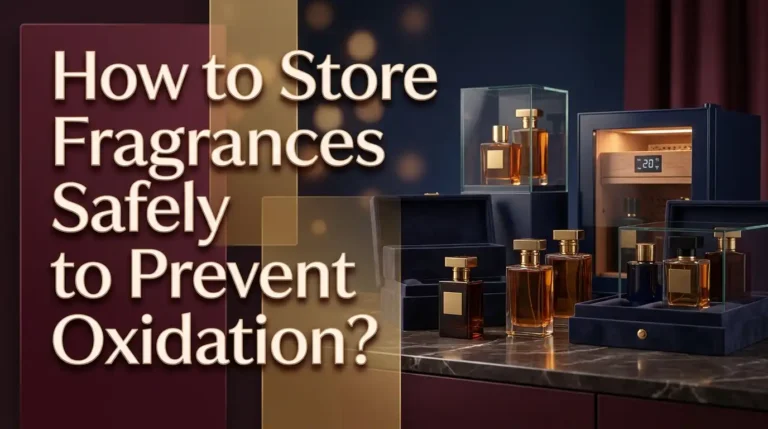
A dedicated closet shelf or a dresser drawer on an interior wall provides the most stable temperature. If you live in a hot climate without air conditioning, think about storing your most valuable bottles in a cooler part of the home. A basement storage area often stays consistently cool. Some serious collectors use a small wine cooler set to around 55°F. This is not required for casual collectors, but it demonstrates how much temperature control helps.
Pros of stable cool storage: Slows evaporation by half or more. Protects delicate top notes. Extends usable life by years. Cons: May require reorganizing your space. Large collections in warm climates may need special solutions.
The Bathroom Is the Worst Room for Your Perfume
This is the most common storage mistake. People keep perfume in the bathroom because it is convenient. You spray it after a shower. It sits right there on the counter. But bathrooms are uniquely bad for fragrance preservation.
Bathrooms have three problems that attack perfume. First, humidity is extremely high. Steam from showers introduces moisture that can seep into bottles with imperfect seals. Water inside the perfume dilutes the concentration and encourages bacterial growth. Second, temperature swings wildly. A hot shower raises the room temperature by 10°F to 20°F within minutes. Then the room cools back down. These cycles stress the fragrance repeatedly. Third, many bathrooms have windows that let in light.
The combined effect is measurable. Perfume stored in a bathroom can show noticeable degradation within six to twelve months. The same bottle kept in a bedroom drawer will stay fresh for three to five years or longer. If your collection currently sits in the bathroom, move it today. A bedroom closet or vanity drawer works much better. You lose a small amount of convenience but gain years of fragrance life.
Pros of moving perfume out of the bathroom: Immediate and significant improvement in longevity. No cost. Easy to do. Cons: Slightly less convenient. You may need to set up a small tray or shelf in another room.
Always Cap Your Bottles After Every Use
This sounds too simple to matter. It matters a lot. The cap on a perfume bottle is not just decorative. It creates a secondary seal that slows air exchange. When you leave the cap off, the atomizer opening is directly exposed to open air. Alcohol vapor escapes freely.
Think about it this way. Every time you spray, air enters the bottle to replace the liquid you used. That air contains oxygen. Oxygen starts the oxidation process immediately. A cap reduces additional air contact between uses. It also blocks dust and light from reaching the atomizer tip.
Make capping a habit. Spray your perfume. Set the bottle down. Put the cap back on immediately. Do not leave it off while you get dressed. Those extra minutes of exposure add up over hundreds of uses. If you lost the cap, keep the bottle in a drawer or wrap a small piece of plastic wrap over the atomizer between uses. Anything that blocks open air helps.
Pros of capping: Costs nothing. Takes one second. Reduces evaporation measurably. Cons: Caps get lost easily. Some designer bottles have loose caps that do not seal well. In those cases, add an extra step like storing in a box.
Store Bottles Upright, Never on Their Side
Perfume bottles should always stand upright. This matters more for long term storage than people expect. When a bottle lies on its side, the liquid presses against the cap or atomizer seal constantly. Over time, the alcohol in the perfume can degrade the rubber gaskets and plastic parts inside the spray mechanism.
A degraded seal means faster evaporation. It also means potential leakage. You might find a sticky residue around the neck of the bottle or notice the liquid level dropping faster than it should. Upright storage keeps the liquid away from the closure. Only air touches the cap, which is exactly what you want.
This rule applies to travel atomizers too. After a trip, transfer any leftover perfume back to the main bottle if possible, or at least store the travel spray upright. For splash bottles, which have no atomizer, upright storage is even more critical. Every time you tip a splash bottle to use it, you expose the full surface of the liquid to air. Keep these bottles tightly closed and upright at all other times.
Pros of upright storage: Protects seals. Prevents leaks. Extends atomizer life. Cons: Some wide bottles are tippy. Use a drawer with dividers or a sturdy shelf to keep them safe.
Keep the Original Box for Every Bottle
The cardboard box your perfume came in is not waste packaging. It is a purpose built shield. Boxes block light completely. They provide insulation against small temperature changes. They protect the glass from bumps and scratches.
The Osmothèque, the world’s official perfume archive in France, stores its collection in darkness at around 54°F (12°C) under inert gas. This is the gold standard for preservation. The original box brings you closer to that standard without any cost or special equipment.
When you finish spraying, return the bottle to its box. This is especially useful for clear bottles, which have zero built in UV protection. But it helps all bottles. If you threw away the box, use an opaque pouch, a cloth bag, or store the bottle in a closed drawer. Any barrier that blocks light and buffers temperature changes is good.
Pros of using original boxes: Zero cost. Blocks all light. Insulates against temperature. Keeps bottles clean. Cons: Takes up more space. You cannot see the bottle. Some boxes wear out over time and may need replacing with an alternative opaque container.
Reduce Air Space in Partially Used Bottles
This is a trick that many collectors do not know about. As you use a perfume, the empty space inside the bottle grows. This space is called headspace. It fills with air. More air means more oxygen. More oxygen means faster oxidation.
A bottle that is 80% empty has a much larger oxygen reservoir than a bottle that is 20% empty. The same perfume in the emptier bottle will degrade faster. The solution is to transfer the remaining perfume into a smaller bottle. This reduces the headspace and slows the oxidation process.
Use a small glass atomizer, not plastic. Glass is non porous and chemically stable. Plastic allows some air to pass through its walls over time. It can also leach chemicals into the perfume. Dark glass is best. Pour carefully or use a clean pipette to transfer the liquid. Leave as little air as possible in the new bottle. Cap it tightly. Store it in the dark.
This technique works especially well for expensive or discontinued fragrances you want to keep for a long time. You sacrifice the original bottle’s appearance but you preserve the scent itself. That is the trade that matters most.
Pros of reducing headspace: Slows oxidation dramatically. Extends life by years. Simple and cheap. Cons: You lose the original bottle’s aesthetic. Transferring liquid always carries a small risk of spillage. Some delicate fragrances may react to the transfer process.
Decant Smartly for Daily Use
One of the best preservation strategies is to decant a small amount of perfume into a travel atomizer for daily use. Leave the main bottle sealed and stored in the dark. This way you open the main bottle only a few times a year instead of every day.
Each time you open a bottle, you let in fresh air. Over a year of daily use, that adds up to a lot of oxygen exposure. A decant reduces this to almost zero. The main bottle stays nearly full. The headspace remains small. Oxidation slows to a crawl.
Choose a glass atomizer with a tight seal. Some collectors wrap Teflon tape around the threads before screwing on the sprayer. This creates a better seal and prevents evaporation from the decant itself. Teflon tape costs very little and you can find it at any hardware store. Use just one or two layers. Too much tape can crack the plastic threading.
Label every decant with the fragrance name and the date you filled it. This prevents confusion later. It also helps you track how long the decant has been sitting. Most decants stay fresh for six to twelve months when stored properly.
Pros of decanting: Protects the main bottle. Reduces daily air exposure. Convenient for travel. Lets you carry scents without damaging original packaging. Cons: Requires buying empty atomizers. Adds a small extra step to your routine. Poor quality atomizers can leak.
Seal Bottles with Parafilm or Teflon Tape for Long Term Storage
For bottles you plan to store for many years without using, physical sealing adds another layer of protection. Two popular methods among fragrance collectors are Parafilm tape and Teflon plumber’s tape.
Parafilm is a stretchy, waxy laboratory tape that creates an airtight moisture resistant seal. Scientists use it to seal test tubes and beakers. You stretch a strip around the neck of the bottle, covering the joint between the bottle and the cap or atomizer. It clings to itself and forms a tight barrier. Parafilm blocks dust and moisture. However, it remains slightly permeable to oxygen and gases over long periods.
Teflon tape works differently. You wrap a thin layer around the threading of the atomizer before screwing it onto the bottle. This fills the microscopic gaps in the threads. Plumbers use the same tape to seal pipe joints. It improves the mechanical seal and reduces vapor escape through the threading. Use no more than two wraps. Too much tape makes it hard to screw the atomizer back on and can stress the plastic.
For maximum protection, combine both methods. Wrap Teflon tape on the threads. Screw the atomizer on. Then stretch a strip of Parafilm around the outside of the neck to cover the entire joint. This two layer approach keeps out almost all external air and keeps in almost all alcohol vapor.
Pros of sealing: Best possible evaporation prevention. Affordable. Proven in laboratory settings. Cons: Takes time and care. Parafilm can leave slight residue. You must remove and reapply the seal each time you use the bottle. Not practical for daily use bottles.
Use Silica Gel Packs to Control Humidity
Moisture is an underrated enemy of perfume. High humidity can seep into bottles with imperfect seals. Once inside, water molecules react with fragrance compounds through hydrolysis. This reaction creates acids that sour the scent. It also dilutes the perfume, weakening its projection.
Silica gel packs absorb moisture from the air. You see them in shoeboxes and electronic packaging. They are cheap and reusable. Place a few silica gel packs in the drawer or storage container where you keep your perfumes. They will maintain a dry environment that protects your bottles.
Do not put silica gel inside the perfume bottle. That would contaminate the fragrance. The packs work by controlling the humidity of the surrounding air. Replace or recharge them every few months. You can recharge silica gel by heating it in an oven at a low temperature to drive off the absorbed moisture.
This tip matters most if you live in a humid climate or if you must store perfumes in a basement or other damp area. Combined with dark, cool storage, humidity control completes the protection triangle.
Pros of silica gel: Very cheap. Reusable. Effective. Works passively. Cons: Requires occasional replacement or recharging. Only helps if your storage area has a humidity problem.
Avoid Frequent Bottle Shaking
Shaking a perfume bottle seems harmless. Many people do it without thinking. But shaking introduces thousands of tiny air bubbles into the liquid. Each bubble increases the surface area where oxygen touches the fragrance. This accelerates oxidation.
Shaking also disturbs the layered structure of older perfumes. Over time, some natural ingredients settle or separate slightly. A gentle swirl is fine if needed. Vigorous shaking is never helpful. The fragrance does not require mixing like a bottle of juice.
Treat your perfume bottles gently. Keep them steady. When you travel, pack bottles so they do not rattle around. A vibrating car ride shakes the bottle continuously. Cushion bottles with soft clothing or store them in a padded case.
Pros of avoiding shaking: Preserves molecular stability. Reduces oxidation rate. Costs nothing. Cons: None. This is purely a habit change with no downside.
Rotate Your Collection and Track Usage
Large collections create a specific problem. Some bottles sit unused for years. During that time, they slowly evaporate and oxidize without you noticing. By the time you reach for the bottle, it may already be degraded.
Set up a simple rotation system. Group your perfumes by season or occasion. Wear your spring scents during spring. Switch to heavier fragrances in fall and winter. This ensures every bottle gets some regular use. You will notice early if a scent starts to change.
Keep a basic list of what you own. Write down the purchase date or the date you opened each bottle. Check your list every few months. A visual inspection takes only a few seconds per bottle. Look at the color. Smell the atomizer nozzle. If anything seems off, test the scent on a paper strip.
A rotation system also helps you enjoy your collection more. You will rediscover forgotten favorites. You will avoid the guilt of watching expensive bottles go to waste. The goal is to use and appreciate what you own while protecting it at the same time.
Pros of rotation: Prevents neglect. Catches problems early. Increases enjoyment of your collection. Cons: Requires a small amount of organization. Very large collections may need a written or digital tracking system.
Know When a Perfume Has Gone Bad
Even with perfect storage, perfumes do not last forever. Most opened fragrances stay at their best for three to five years. Some last a decade or more. But all will eventually degrade. Knowing the signs helps you decide what to keep and what to let go.
The smell changes. This is the clearest sign. A fresh perfume smells bright and balanced. A degraded perfume smells sour, metallic, vinegary, or simply flat. The top notes disappear first. You might notice a sharp alcohol scent that was not there before. The base notes may smell stale or waxy.
The color darkens. Clear or pale perfumes that turn yellow, amber, brown, or murky have oxidized. Some color change is natural, especially in vanilla heavy fragrances. Vanillin naturally darkens over time and does not always mean the scent is ruined. But a dramatic color shift combined with a changed smell confirms degradation.
The texture changes. Cloudiness, sediment at the bottom, or an oily layer on top signals that the formula has separated. This perfume is no longer stable. Do not use it on your skin. It may cause irritation or rashes.
When a perfume goes bad, you can still repurpose it. Use it as a room spray in a well ventilated area. Add a few drops to unscented lotion for a weak body scent. But never apply degraded perfume directly to sensitive skin. The oxidized compounds can trigger allergic reactions.
Pros of knowing the signs: You avoid using spoiled perfume on skin. You free up storage space. You learn which bottles degrade fastest. Cons: It is always sad to lose a favorite fragrance. Some people hold onto bottles for sentimental reasons even after they have turned.
Preserve Discontinued and Sentimental Fragrances Forever
Some perfumes hold deep emotional value. A discontinued scent you will never find again. A bottle that belonged to someone you love. These deserve extra care.
Follow the most protective method: keep the bottle in its original box. Store it in a cool, dark, dry place with stable temperature. Add a silica gel pack to the storage container. Seal the neck with Parafilm if the bottle will not be used for years. Decant a small working vial if you want to wear the scent occasionally without opening the main bottle.
Some fragrance collectors go further and use inert gas sprays. These products, originally made for wine preservation, spray a layer of argon or nitrogen gas into the bottle. The inert gas sits on top of the perfume and blocks oxygen contact. This is an advanced technique for rare and expensive bottles. It is not needed for everyday fragrances.
The Osmothèque conservatory keeps its archived scents under argon gas at a steady 54°F. This level of care can preserve a perfume for decades with minimal change. You can apply the same principles at home without the professional equipment. Darkness, cool temperature, and minimal air contact are the principles that matter.
Pros of preservation methods: Protects irreplaceable bottles. Extends life by decades. Honors sentimental value. Cons: Requires discipline. You may forget about bottles stored away for years. Check on them periodically.
Frequently Asked Questions
Does perfume expire if the bottle is unopened?
An unopened perfume stored in its original box in a cool dark place can last for many years, often five to ten or longer. The seal prevents air from entering and starting oxidation. The packaging blocks light. Manufacturers typically print a shelf life of around 30 months on the bottle, but this is a conservative estimate. Many unopened perfumes remain perfect far beyond that date. The key is consistent cool and dark storage.
Can I store perfume in the refrigerator?
A standard refrigerator is too cold and too humid for perfume. The temperature cycles as the fridge compressor turns on and off. Condensation can form on the glass when you take the bottle out. This moisture can seep into the bottle. A dedicated wine cooler set to around 55°F works well for long term storage, but a regular kitchen fridge does more harm than good. A cool dark closet or drawer is much better.
Why did my perfume turn dark brown?
Darkening is usually caused by oxidation. Air enters the bottle and reacts with fragrance molecules. Certain natural ingredients like vanilla, tonka bean, and patchouli also darken naturally with age. This does not always mean the perfume is ruined. If the scent still smells normal and good, the color change is cosmetic. If the scent has turned sour or metallic, the perfume has degraded.
How can I tell if my perfume has evaporated or if someone is using it?
Check for physical signs. Look for sticky residue around the atomizer or cap. This means evaporation through a poor seal. Smell the nozzle. A strong alcohol scent at the tip often indicates slow leakage. If the bottle cap fits loosely, alcohol vapor can escape. Keep bottles in a place only you access. If you still suspect someone else is using your perfume, store the most valuable bottles hidden away.
Should I throw away perfume that has changed color but still smells fine?
No. Color change alone is not a reason to discard a perfume. Many fragrances darken naturally, especially those with vanilla, amber, or citrus oils. The scent is what matters. If the fragrance smells as good as it always did, keep using it. Do a patch test on a small area of skin first if you are concerned about irritation. Most darkened perfumes are still perfectly safe to wear.
Do plastic bottles cause more evaporation than glass bottles?
Yes. Plastic is slightly permeable. Air and vapor can pass through plastic walls very slowly over months and years. Glass is impermeable and chemically inert. It does not interact with the perfume and does not allow anything to pass through its walls. Always prefer glass bottles for long term storage. Avoid keeping perfume in plastic decant bottles for more than a few months.
What is the single most important thing I can do to stop evaporation?
Move your perfume to a cool, dark, dry place and always replace the cap tightly after every use. If you change nothing else, this one shift will extend the life of your collection by years. Darkness prevents photo oxidation. Cool temperatures slow evaporation. A tight cap blocks air exchange. These three simple habits do more than any special equipment or advanced technique.

Hi, I’m Lily! I started this blog to share honest reviews, real comparisons, and helpful guides so you can find your perfect scent without the guesswork. Welcome to my scented world!