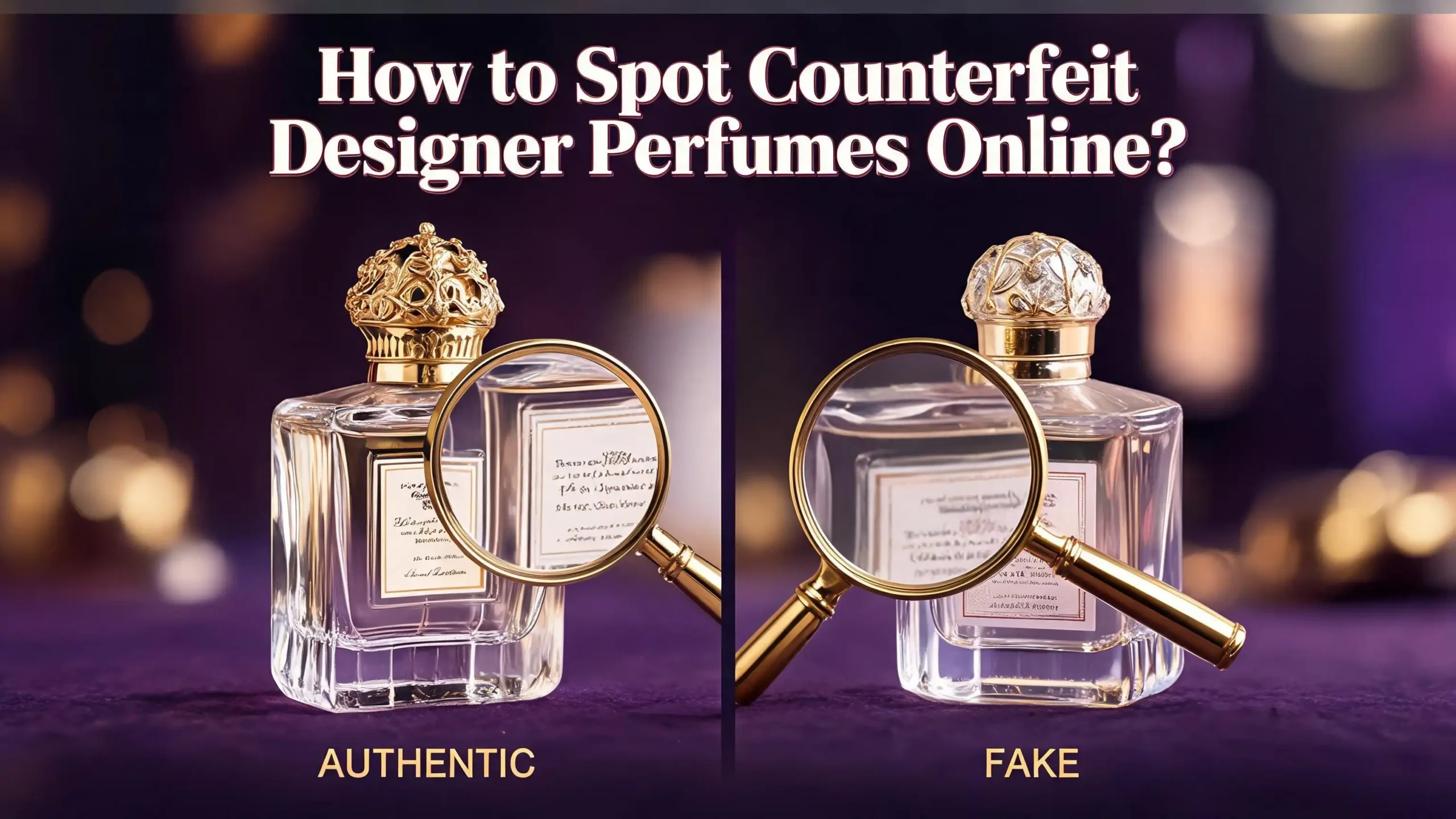
How to Spot Counterfeit Designer Perfumes Online?
You found a stunning deal on your favorite designer perfume. The price is 70% off retail, the listing looks professional, and the seller has decent reviews. You hit “buy.” A week later, the package arrives, and something feels off. The scent fades in minutes. The cap wobbles. The box looks cheap.
You just bought a counterfeit perfume.
The worst part? Counterfeit perfumes do not just waste your money. The FBI has found that fake cosmetics and fragrances often contain arsenic, cadmium, antifreeze, and even urine. These products skip every safety regulation that protects consumers. Spraying a counterfeit perfume on your skin is a genuine health risk.
This guide gives you every tool you need to identify fake designer perfumes before you buy. You will learn how to examine packaging, inspect bottles, verify batch codes, evaluate sellers, and test scent quality. Each section breaks down a specific red flag so you can shop with full confidence.
Key Takeaways
- Price is the first warning sign. Designer perfumes rarely go on sale for more than 20% to 30% off retail. If you see a deal with 50% or more off the original price, treat it as a major red flag. Counterfeiters rely on deep discounts to attract buyers who want luxury fragrances at bargain prices.
- Packaging quality reveals the truth fast. Authentic designer perfumes use thick cellophane, heavy cardboard, sharp printing, and precise logos. Fake perfumes almost always have thin wrapping, flimsy boxes, blurry text, or spelling errors. These small details are easy to spot once you know what to look for.
- Batch codes must match on the box and bottle. Every genuine perfume has a batch code printed on the box and engraved or printed on the bottle. These codes must be identical. Mismatched, missing, or poorly printed batch codes are strong indicators of a counterfeit product.
- The scent test is the ultimate proof. Real perfumes have a layered structure of top, heart, and base notes that evolve on your skin over several hours. Fake perfumes smell flat, fade within an hour, and often leave behind a harsh chemical or alcohol smell.
- Always buy from authorized retailers. The safest way to avoid counterfeit perfumes is to purchase directly from brand boutiques, authorized department stores, or verified online retailers. Check the brand’s official website for a list of approved sellers before you order.
- Use multiple verification methods together. No single check is foolproof. Combine price analysis, packaging inspection, batch code verification, scent testing, and seller research to build a complete picture of authenticity.
Why Counterfeit Perfumes Are a Growing Problem Online
Online shopping created the perfect environment for counterfeit perfume sellers to thrive. Physical stores allow you to test a fragrance, inspect the box, and verify the retailer’s credentials. Online shopping removes all of those safeguards.
The global perfume market was valued at $60 billion in 2025 and continues to grow rapidly. This growth attracts counterfeiters who see enormous profit potential with minimal risk. Fake perfumes cost very little to produce because manufacturers use cheap synthetic chemicals, skip safety testing, and copy packaging designs from photographs.
Social media platforms have made the problem worse. Sellers promote “authentic” designer fragrances through Instagram stories, TikTok videos, and Facebook marketplace listings. Many of these sellers operate from anonymous accounts and disappear after a few weeks of sales. Buyers have no recourse once the seller vanishes.
Third party marketplace platforms also present significant risk. While platforms like eBay and Amazon have buyer protection programs, counterfeit sellers often use tactics like stolen product photos, copied batch codes, and fake positive reviews to appear legitimate. The sheer volume of listings makes it difficult for platforms to catch every counterfeit product.
Understanding the scale of this problem is the first step toward protecting yourself. The counterfeit perfume industry is not a small operation run by a few bad actors. It is a global network that generates billions of dollars in revenue each year.
Check the Price Before You Buy Anything Else
Price is the fastest and most reliable initial screening tool. Designer perfumes cost what they do for real reasons. A single fragrance can take up to a year to develop, with hundreds of trial formulations. Brands use rare natural ingredients like oud, iris butter, and sandalwood that cost thousands of dollars per kilogram.
A 100ml bottle of a luxury fragrance from brands like Creed, Tom Ford, or Chanel typically retails between $150 and $500. These prices reflect the cost of raw materials, formulation expertise, safety testing, packaging design, and brand value.
Authorized retailers sometimes offer promotions of 20% to 30% off, especially during holiday seasons or clearance events. Anything beyond that range should raise immediate suspicion. A listing advertising 60% or 70% off a current designer fragrance is almost certainly selling a fake product.
Some sellers try to justify extreme discounts with vague explanations like “overstock,” “factory direct,” or “wholesale pricing.” Legitimate brands control their distribution tightly. They do not sell excess inventory to random online sellers at deep discounts.
Before purchasing any perfume online, check the retail price on the brand’s official website or at a major department store. Compare that number to the listing price. If the gap is too large to explain, walk away.
Examine the Cellophane Wrapping and Outer Box
The packaging of a designer perfume is an extension of the brand’s identity. Luxury houses invest heavily in every detail of the unboxing experience. This attention to detail is exactly where counterfeiters cut corners.
Start with the cellophane wrap. Authentic perfumes use thick, tightly fitted cellophane that hugs the box without any wrinkles or gaps. The folds are crisp and symmetrical. The seams are clean and sealed with precision. You should not see any glue residue, air bubbles, or loose edges.
Counterfeit products often use thin, crinkly plastic wrap that sits loosely around the box. The folds may be uneven, the seams may overlap sloppily, and you might notice visible glue marks. This is one of the easiest red flags to spot because high quality cellophane wrapping requires specialized machinery that most counterfeit operations do not have.
Next, pick up the box and feel its weight. Authentic designer perfume boxes use heavy, rigid cardboard that feels substantial in your hand. The box should hold its shape firmly. Counterfeit boxes are often made from thin, flimsy material that bends easily under pressure.
Look closely at the printing on the box. Genuine packaging features razor sharp text, perfectly aligned logos, and rich, consistent colors. Run your finger over the brand name. On many authentic products, it is slightly embossed or raised. Counterfeit boxes often have blurry text, slightly off colors, or logos that look stretched or distorted.
Look for Spelling Errors and Label Details
This check sounds obvious, but spelling mistakes remain one of the most common giveaways on counterfeit perfume packaging. Counterfeiters often operate in countries where the brand’s language is not the primary language. Small errors slip through their quality control, assuming they have any quality control at all.
Look for misspellings of common terms. “Parfume” instead of “parfum,” “Eau de Toilete” instead of “Eau de Toilette,” or “Made in Frence” instead of “Made in France” are real examples found on seized counterfeit products. Even a single misplaced letter is an instant red flag.
Beyond spelling, check for required label information. Regulations in the EU and the US require perfume packaging to display specific details. These include a list of ingredients, allergen information, a barcode, a batch number, the volume of the product, and the country of origin. The absence of any of these elements should raise concern.
Font consistency is another important detail. Authentic packaging uses a single, carefully chosen typeface that matches the brand’s official design standards. Counterfeit products sometimes mix fonts, use slightly different letter spacing, or display text in a weight that does not match the brand’s style.
Pay attention to the quality of any images or decorative elements on the box as well. Genuine products use high resolution printing with clean edges and vibrant colors. Counterfeit packaging may show pixelated images, faded colors, or blurry decorative patterns that look like low quality reproductions.
Inspect the Perfume Bottle for Quality and Symmetry
The bottle itself is one of the hardest elements for counterfeiters to replicate perfectly. Luxury perfume bottles are manufactured to exact specifications using high quality glass and precision molding techniques.
Pick up the bottle and feel its weight. An authentic designer perfume bottle feels heavy and solid in your hand. The glass is typically thick and clear with no visible imperfections. Counterfeit bottles often feel surprisingly light because manufacturers use thinner, cheaper glass.
Examine the glass surface carefully. Authentic bottles are smooth, uniform, and free of air bubbles, rough patches, or visible mold seams. Counterfeit bottles frequently have tiny air bubbles trapped in the glass, rough spots near the base, or visible seam lines running along the sides where the mold came together.
Hold the bottle up and check its symmetry from every angle. Genuine perfume bottles are perfectly symmetrical. If the bottle looks slightly lopsided, if the label sits crooked, or if any element appears uneven, you are likely looking at a counterfeit.
The color of the liquid inside can also provide clues. Compare the color to official product photos on the brand’s website. Counterfeit perfumes often have a slightly different shade because the chemical composition differs from the original formula.
Test the Cap, Collar, and Sprayer Mechanism
The cap and sprayer are areas where counterfeiters consistently fail to match authentic quality. Luxury brands engineer these components to fit perfectly and function smoothly. Every detail is intentional.
An authentic perfume cap clicks into place with a satisfying, secure fit or closes with a smooth magnetic pull. The cap feels balanced and substantial. It is often made from real metal, dense resin, or high grade plastic with a quality finish.
Counterfeit caps are usually made from lightweight plastic. They wobble, fail to close flush against the bottle, or feel disproportionately light compared to the bottle itself. A cap that does not sit straight or that pops off too easily is a strong indicator of a fake product.
Check the collar around the sprayer. On authentic bottles, the collar sits flush against the bottle’s neck with no visible gaps. It looks like an integrated part of the design. On counterfeit bottles, the collar often appears as a separate, cheaply attached piece that does not blend with the rest of the bottle.
Test the sprayer by pressing it several times. A genuine atomizer produces a fine, even mist that disperses the fragrance smoothly. Counterfeit sprayers often produce a wet stream instead of a mist, may leak around the collar, or feel stiff and sticky when pressed.
Look inside the bottle at the dip tube, which is the thin plastic straw that draws liquid from the bottom. In authentic bottles, this tube is almost invisible, perfectly straight, and cut to the right length. In fakes, the tube is often too long, causing it to bend, or it is made from thick, cloudy plastic.
Verify the Batch Code on the Box and Bottle
Batch codes are one of the most powerful tools for identifying counterfeit perfumes. Every authentic perfume has a unique alphanumeric code that identifies its specific production run. This code appears in two places: on the box and on the bottle.
Find the batch code on the box first. It is usually located on the bottom, back, or side flap of the box, near the barcode. The code typically contains 3 to 11 characters and is a mix of letters and numbers. On the bottle, look for the code on the base of the glass. It is often laser engraved, stamped, or printed.
The most critical check is simple: the batch code on the box must exactly match the batch code on the bottle. If these codes differ, the product has been tampered with or is counterfeit. If either code is missing entirely, that is also a serious red flag.
Examine the quality of the printing or engraving. Authentic batch codes are applied with precision. They are clear, crisp, and difficult to rub off. Counterfeit batch codes are often smudged, blurry, poorly aligned, or printed on a cheap sticker that can be peeled away. Laser engraved codes on the bottle base are particularly hard for counterfeiters to replicate because the process requires expensive specialized equipment.
You can also use free online tools like CheckFresh or CheckCosmetic to decode batch codes. Enter the brand and code, and the tool will return an estimated manufacturing date. If the date seems implausible, such as a date in the future or before the product was launched, the code is likely fake.
However, remember that batch code verification alone is not foolproof. Counterfeiters can copy valid batch codes from authentic products. Online databases can also be incomplete or outdated. Always combine batch code checks with the other methods described in this guide.
Use QR Codes and Brand Verification Tools
Many designer perfume brands now include QR codes on their packaging as an additional layer of authentication. These codes link directly to the brand’s verification system and can confirm whether a specific product is genuine.
Before scanning any QR code, inspect its physical quality. Authentic QR codes are printed sharply, centered on the packaging, and positioned consistently according to the brand’s design standards. Counterfeit QR codes may appear blurry, off center, or printed at a different size than expected.
When you scan a QR code, check the URL it directs you to before clicking. The link should go to the brand’s official domain. If the QR code sends you to an unfamiliar website, a suspicious URL, or a generic landing page, do not enter any personal information. This could be a phishing attempt.
Some brands offer dedicated authentication portals on their official websites. You can enter your batch code, serial number, or other product details to verify authenticity directly with the manufacturer. Chanel, Dior, and several other major houses have invested in these systems to help consumers fight counterfeits.
If a brand does not offer online verification, you can contact their customer service team directly. Provide clear photos of the box, bottle, batch codes, and any other identifying details. Many brands will confirm whether your product matches their production records.
Research the Seller’s Reputation and History
The seller’s credibility is just as important as the product itself. Even a perfectly packaged counterfeit can fool you if you skip this step. Due diligence on the seller can prevent problems before they start.
On marketplace platforms, check the seller’s account age and transaction history. A seller with thousands of completed transactions over several years is far more trustworthy than a new account with a handful of sales. New accounts selling luxury fragrances at deep discounts should trigger immediate caution.
Read recent reviews carefully. Do not just look at the overall star rating. Look for reviews that specifically mention fragrance authenticity, packaging quality, and product accuracy. Generic positive reviews like “fast shipping” or “great seller” are less useful because they do not confirm the product is genuine.
When shopping on unfamiliar websites, look for signs of a legitimate business. These include a physical address, a customer service phone number, a professional email address, clear return policies, and an authenticity guarantee. If the only contact option is a generic form with no other business details, proceed with extreme caution.
Check whether the brand’s official website lists the seller as an authorized retailer. Most luxury brands publish a directory of approved distributors. If the website you are considering is not on that list, the risk of receiving a counterfeit product increases significantly.
Perform a Scent and Longevity Test After Purchase
If you have already bought a perfume and want to verify its authenticity, the scent test is your most powerful tool. No counterfeiter has successfully replicated the full olfactory complexity of a genuine designer fragrance.
Authentic perfumes are built on a three layer scent pyramid. The top notes are the bright, initial burst you smell in the first 5 to 15 minutes. The heart notes emerge over the next 20 to 60 minutes and form the core character of the fragrance. The base notes appear last and can linger for 6 to 12 hours on the skin.
Spray the perfume on your wrist and observe its behavior over time. A genuine designer perfume will evolve and change character as the hours pass. You will notice distinct transitions between the layers. The scent will feel balanced, smooth, and complex at each stage.
A counterfeit perfume behaves very differently. It may smell strong and somewhat similar to the original in the first few seconds. But within 30 to 60 minutes, the scent collapses. It either disappears entirely or degrades into a harsh, synthetic, alcohol heavy smell. There is no layered evolution, no smooth transition, and no lasting base notes.
Perform this four step longevity test. First, spray your wrist and note your immediate impression. Second, check at the one hour mark for the heart note transition. Third, check at three hours for the base notes. Fourth, check at six hours for any remaining scent. If the fragrance is gone within an hour or two, it is almost certainly not authentic.
Understand the Health Risks of Fake Fragrances
Counterfeit perfumes are not just a financial loss. They are a genuine health hazard. The chemicals found in seized counterfeit fragrances should alarm every consumer.
The FBI has reported that counterfeit cosmetics and fragrances often contain arsenic, beryllium, and cadmium, all of which are known carcinogens. Other investigations have found antifreeze, bacteria, and the probable carcinogen DEHP in fake perfume samples. These substances are never found in legitimate products because real brands follow strict safety regulations.
Legitimate perfume manufacturers comply with IFRA (International Fragrance Association) safety standards and conduct extensive dermatological testing before any product reaches the market. A safety dossier is filed with poison control authorities. This entire process ensures that the final product is safe for direct skin application.
Counterfeit manufacturers skip every one of these steps. Their products are mixed in unregulated facilities with no quality control, no ingredient testing, and no safety oversight. The result is a product that can cause skin rashes, chemical burns, allergic reactions, respiratory problems, headaches, and dizziness.
People with sensitive skin, allergies, or respiratory conditions face even greater risk. If you suspect you have purchased a counterfeit perfume, stop using it immediately. Do not attempt to use up the product to “get your money’s worth.” The health risk is not worth it.
Know What to Do If You Bought a Counterfeit
Discovering you bought a fake perfume is frustrating, but you have options for recourse. Act quickly and document everything.
Stop using the product immediately. Set it aside and do not spray it again. You do not know what chemicals it contains, and continued use poses unnecessary health risks.
Take clear, well lit photographs of every element of the product. Photograph the box from all angles, the cellophane wrap, the bottle, the cap, the batch codes on both the box and bottle, and any other details that look suspicious. These photos will serve as evidence for your refund or dispute claim.
If you purchased through a marketplace like eBay or Amazon, open a dispute through the platform’s buyer protection program. Upload your photos and explain that you received a counterfeit product. Most major platforms have policies that protect buyers against counterfeit goods and will issue refunds.
If you paid with a credit card, you can also file a chargeback with your card issuer. Contact your credit card company, explain that you received counterfeit merchandise, and provide your documentation. Credit card companies routinely handle these disputes and will guide you through the process.
You can also report the seller to the marketplace and to consumer protection authorities. Reporting helps platforms identify and remove counterfeit sellers, which protects future buyers. In the US, you can report counterfeit goods to the National Intellectual Property Rights Coordination Center.
Frequently Asked Questions
Can a perfume be fake even if it comes in a sealed box with cellophane wrap?
Yes, absolutely. Counterfeiters frequently wrap their products in cellophane to mimic the appearance of a factory sealed item. However, the quality of the wrap often reveals the truth. Authentic cellophane is thick, taut, and precisely folded. Fake cellophane tends to be thin, loose, and unevenly applied. A sealed box alone does not guarantee authenticity. Always combine the cellophane check with batch code verification, bottle inspection, and price analysis.
Are batch code checker websites always accurate?
No. Online batch code checkers like CheckFresh and CheckCosmetic are useful tools, but they rely on third party databases that may be incomplete or outdated. Luxury brands frequently change their batch code formats to combat counterfeiting, and these changes may not be reflected immediately in online tools. A code that returns “unknown” does not automatically mean the product is fake. Similarly, a recognized code does not guarantee authenticity because counterfeiters can copy valid codes from genuine products.
Is it safe to buy “tester” or unboxed perfumes online?
Tester perfumes are genuine products that brands supply to department stores for customer sampling. They contain the same fragrance as retail bottles but typically come in plain packaging marked “Tester, Not for Sale.” Buying testers from reputable sources can save you money. However, the unboxed format makes it much easier for counterfeiters to sell fakes because they do not need to replicate the retail packaging. Only buy testers from sellers with established reputations and verifiable track records.
How can I tell if an online perfume seller is authorized?
Visit the brand’s official website and look for a list of authorized retailers or distributors. Most luxury perfume brands publish this information. If the online store you are considering does not appear on that list, contact the brand’s customer service team to confirm. Authorized retailers have direct supply chain relationships with brands, which significantly reduces the chance of counterfeit products entering their inventory.
Can the same authentic perfume look different in different countries?
Yes. Brands sometimes adjust packaging design, labeling, and even formulation for different markets. Regulatory requirements vary by country, so ingredient lists and warning labels may look different. Packaging redesigns also mean that a bottle purchased in 2020 may look slightly different from one purchased in 2025. The key difference between a legitimate regional variation and a fake is the quality of materials and printing. An authentic product will always maintain high quality packaging regardless of the market.
What should I do if the brand cannot verify my perfume’s batch code?
If a brand’s customer service team cannot confirm your batch code, it does not automatically mean the product is fake. Some brands do not offer public batch code verification for security reasons. However, if the brand raises concerns about the code format, packaging, or your purchase source, take their feedback seriously. Request a refund from the seller, stop using the product, and consider purchasing a replacement from an authorized retailer to ensure you receive a genuine fragrance.

Hi, I’m Lily! I started this blog to share honest reviews, real comparisons, and helpful guides so you can find your perfect scent without the guesswork. Welcome to my scented world!