How to Make Perfume Last All Day on Dry Skin?
You love your perfume. You spray it every morning. But by lunchtime, the scent has vanished. If this sounds familiar, your dry skin is likely the culprit. Dry skin lacks the natural oils that help fragrance molecules cling to the surface. Without that oily layer, perfume evaporates fast and leaves you wondering if you even applied it at all.
This is a common frustration. People with dry skin often report that their perfume fades within one to two hours, while those with oilier skin enjoy the same scent for six hours or more. The good news is that you do not need to switch your entire perfume collection or spend more money. You just need to change how and where you apply your fragrance.
This blog post gives you clear, step by step solutions that will keep your perfume lasting from morning to night. Every tip here is backed by fragrance science and expert advice, so you can stop guessing and start smelling great all day long.
Key Takeaways
- Moisturize before you spray. Dry skin causes perfume to evaporate quickly. Applying an unscented lotion or body oil to your pulse points creates a base that holds fragrance molecules in place for hours longer.
- Use petroleum jelly as a scent lock. A thin layer of Vaseline on your wrists and behind your ears acts as a sticky barrier that traps the perfume and slows down evaporation significantly.
- Choose higher fragrance concentrations. Eau de Parfum (15% to 20% oil) and Parfum (20% to 40% oil) last far longer than Eau de Toilette (5% to 15% oil). Stronger concentrations give dry skin more scent to hold onto.
- Spray on pulse points, not just anywhere. Areas like your wrists, neck, inner elbows, and behind your knees emit heat. This warmth activates and projects fragrance throughout the day.
- Layer your fragrance from shower to spray. Using a matching body wash, lotion, and perfume builds multiple layers of scent. Each layer reinforces the others, creating a longer lasting fragrance experience.
- Spray on clothes and hair for extra longevity. Fabric and hair hold scent far longer than skin. A light mist on your shirt collar or a spritz on your hairbrush adds hours to your perfume’s life.
Why Perfume Fades Faster on Dry Skin
Understanding the science behind fragrance evaporation helps you fix the problem at its root. Perfume is made of fragrance oil dissolved in alcohol. When you spray it on your skin, the alcohol evaporates first and leaves behind the scent molecules. These molecules then bind to the natural oils and lipids on your skin’s surface.
Dry skin has far fewer of these natural oils. Without that lipid layer, the fragrance molecules have nothing to anchor to. They float on the surface briefly and then evaporate into the air. This is why two people can wear the same perfume and get completely different results.
Oily skin works like a natural sponge for fragrance. The sebum on oilier skin types binds with scent molecules and releases them slowly over time. Dry skin, on the other hand, lets those same molecules escape within minutes. Hydration levels, pH balance, and even body temperature all play a role in how long a scent lasts. People with warmer skin may project scent better initially, but the fragrance can also burn off faster. Those with cooler, drier skin often experience the worst of both issues: low projection and short longevity.
The solution is straightforward. You need to create a moisture barrier that mimics what oily skin does naturally. The following sections show you exactly how to do that.
Moisturize Your Skin Before Applying Perfume
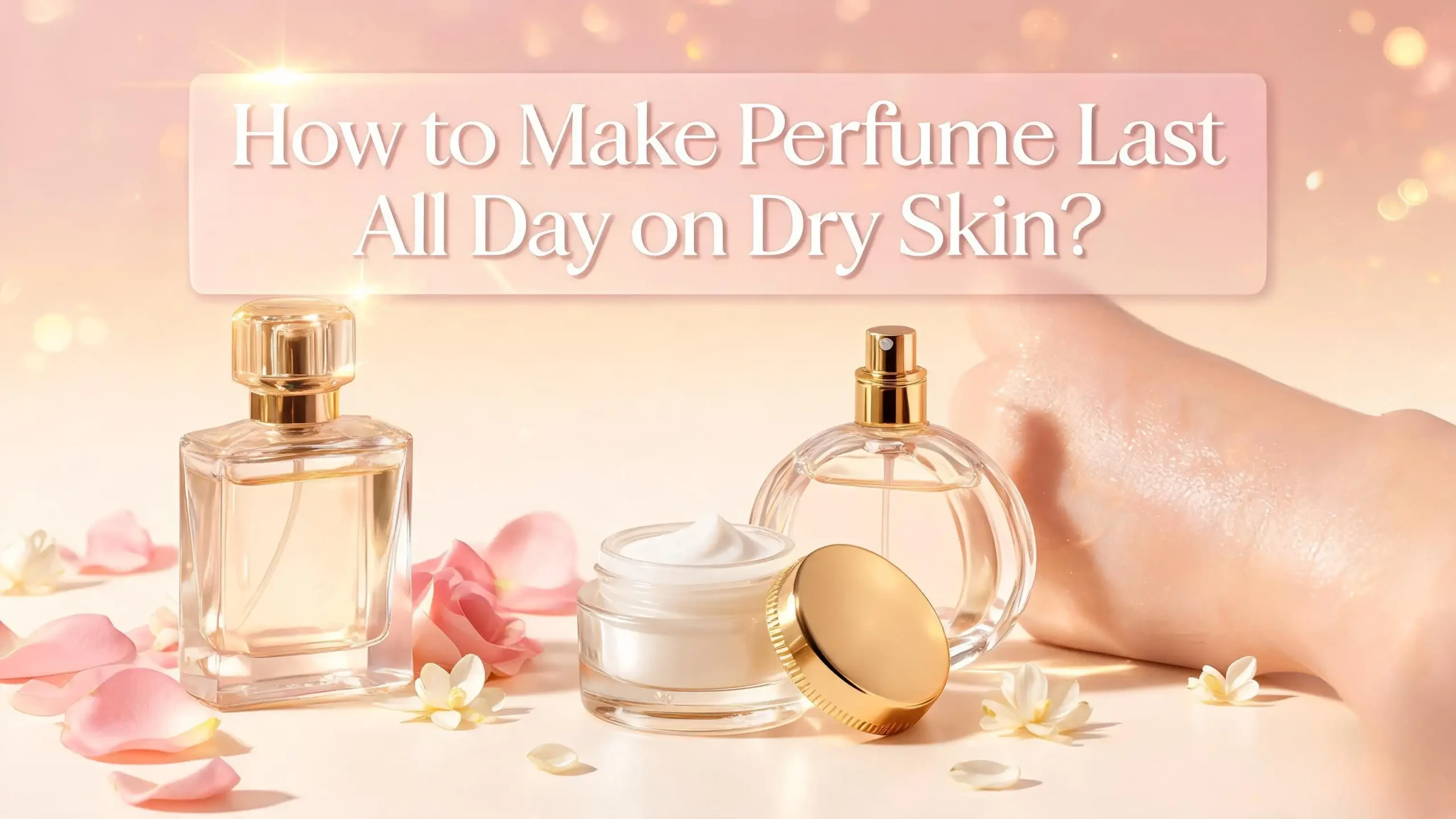
This is the single most important step for anyone with dry skin. Applying an unscented moisturizer to your pulse points before spraying perfume can double or even triple your fragrance’s longevity. The moisturizer creates a hydrated surface that traps scent molecules and prevents rapid evaporation.
Use an unscented lotion so that it does not compete with your perfume’s scent profile. Scented lotions can clash with your fragrance and create an unpleasant mix. Apply the lotion right after you shower while your skin is still slightly damp. This locks in the maximum amount of moisture.
Wait about two to three minutes for the lotion to absorb before you spray your perfume. If you spray too soon, the fragrance can slide off the lotion. If you wait too long, the lotion may dry out. That short window is the sweet spot. Focus on your wrists, neck, chest, inner elbows, and behind your ears. These are the areas where your perfume will go, so these are the areas that need moisture the most.
Many fragrance experts recommend jojoba oil as an ideal base because its composition closely resembles human sebum. A few drops of jojoba oil rubbed into your pulse points gives your skin the lipid layer it naturally lacks.
Use Petroleum Jelly as a Fragrance Anchor
Petroleum jelly is one of the oldest tricks in the perfume world. A thin layer of Vaseline on your pulse points creates a waxy barrier that holds fragrance molecules close to the skin. This prevents the scent from evaporating as quickly as it would on bare, dry skin.
The technique is simple. Take a small amount of unscented petroleum jelly on your fingertip. Dab it lightly on your wrists, behind your ears, on your neck, and on any other spot where you plan to spray perfume. You do not need a thick layer. A barely visible film is enough.
The petroleum jelly works because it is an occlusive. Occlusives sit on top of the skin and prevent moisture loss. In this case, they also prevent fragrance loss. The scent molecules get trapped in the jelly layer and release slowly throughout the day instead of evaporating all at once.
This method is especially useful for expensive perfumes where every spray counts. You get more value from each application because the scent sticks around longer. Some people report gaining an extra three to four hours of wear time by adding this one simple step to their routine. It costs almost nothing and takes about ten seconds.
Apply Perfume Right After You Shower
Timing matters more than most people realize. Your skin is most receptive to fragrance right after a warm shower. The heat opens your pores, and the moisture on your skin creates the perfect environment for scent absorption.
Do not towel dry completely. Pat yourself lightly so that your skin remains slightly damp. Then apply your moisturizer and let it settle for a minute or two. Spray your perfume while your skin still has that fresh, hydrated quality. The fragrance molecules will absorb deeper into the skin instead of just sitting on a dry surface.
Hot water also softens the outer layer of your skin. This makes it easier for the perfume to penetrate and bind with the moisture below. If you apply perfume to cold, dry skin hours after your shower, you miss this window of maximum absorption.
Make your perfume application part of your post shower routine, not an afterthought as you walk out the door. This small change in timing can add hours to your scent’s lifespan without spending any extra money or changing your fragrance.
Spray Perfume on Your Pulse Points
Pulse points are areas where blood vessels sit close to the skin’s surface. These spots generate more body heat, which helps activate and project fragrance throughout the day. The warmth causes scent molecules to lift off your skin gently, creating a natural diffusion effect.
The best pulse points for perfume application include your wrists, the sides of your neck, behind your ears, the inner elbows, behind your knees, and the center of your chest. Each of these spots radiates warmth consistently, which keeps your fragrance alive and noticeable.
Avoid spraying in just one spot. Distributing the fragrance across multiple pulse points creates a subtle scent cloud that moves with you. Someone standing nearby will catch hints of your perfume without being overwhelmed by a single concentrated area.
One critical mistake to avoid is rubbing your wrists together after spraying. This friction generates heat that breaks down the top notes of your perfume prematurely. The delicate opening notes disappear, and you skip straight to the middle and base notes. Instead, spray each wrist separately and let the perfume dry naturally. This preserves the full scent evolution from top to base notes as the perfume was designed to unfold.
Choose the Right Fragrance Concentration
Not all perfumes are created equal. The concentration of fragrance oil in a bottle directly determines how long the scent will last. For dry skin, choosing a higher concentration is one of the most effective ways to ensure all day wear.
Eau de Cologne contains about 2% to 5% fragrance oil and lasts roughly two to three hours. Eau de Toilette holds 5% to 15% and typically gives three to five hours. Eau de Parfum has 15% to 20% oil and can last five to eight hours. Parfum, also called Extrait, contains 20% to 40% oil and often lasts twelve hours or more.
If your skin eats fragrance quickly, Eau de Toilette may not be strong enough. Jumping to Eau de Parfum or Parfum gives you a significantly higher dose of scent molecules per spray. More molecules means more for your skin to hold onto, even without a strong lipid layer.
Parfum and Extrait formulations also tend to use heavier base notes like amber, musk, vanilla, and woods. These notes have larger molecules that evaporate slowly. Lighter notes like citrus and green florals have smaller molecules that vanish fast. Choosing a fragrance with a strong base note foundation gives dry skin a much better chance of holding the scent.
Pick Fragrances With Long Lasting Note Profiles
The specific notes in your perfume affect longevity just as much as the concentration. Fragrances built around heavy base notes will always outlast those centered on light top notes, regardless of your skin type.
Base notes like oud, sandalwood, patchouli, vanilla, amber, tonka bean, and musk are the longest lasting ingredients in perfumery. These molecules are heavy and evaporate slowly. A perfume with a dominant base note profile can easily last six to ten hours, even on dry skin.
Middle notes like rose, jasmine, cinnamon, and cardamom provide moderate longevity. They typically last two to four hours and bridge the gap between the opening and the dry down of a fragrance.
Top notes like bergamot, lemon, grapefruit, and mint are the most fleeting. They create that beautiful first impression, but they burn off within 15 minutes. If you find yourself constantly reapplying perfume, you might be wearing a fragrance that leans too heavily on top notes. Look for scents described as warm, woody, oriental, or gourmand. These families tend to have the strongest lasting power and will perform better on skin that struggles to hold lighter compositions.
Layer Your Fragrance for Maximum Longevity
Fragrance layering is the practice of using multiple scented products in the same scent family to build depth and extend wear time. This technique creates several layers of fragrance on your body, each one reinforcing the others.
Start in the shower with a body wash in the same scent or a complementary scent family. Follow with a matching body lotion or cream applied to damp skin. Then spray your perfume on your pulse points. Each layer adds another dimension of fragrance that the others support.
You can also layer different formats of the same fragrance. Apply a perfume oil or solid perfume to your wrists and neck first. Then spray Eau de Parfum over the top. The oil base underneath grabs onto the spray and holds it much longer than bare skin would.
If your perfume brand does not offer matching body products, use an unscented lotion as your base layer. This still provides the moisture barrier that dry skin needs. The key is to avoid using a different scented lotion that might clash with your perfume. Layering works best when all the products either match or share similar note families like vanilla, amber, or musk.
Spray Perfume on Your Clothes and Hair
Fabric holds fragrance far longer than skin does. Natural fibers like cotton, wool, and linen can retain scent for an entire day or even longer. Spraying a light mist on your shirt collar, inside your jacket, or on your scarf gives you a lasting backup scent source.
Keep the nozzle at least six to eight inches away from the fabric to prevent concentrated spots that could stain. Light colored and delicate fabrics should be tested in a hidden area first. Darker fabrics and sturdy materials like denim or cotton blends typically handle perfume spray well.
Hair is another excellent fragrance carrier. The fibers in your hair trap scent molecules and release them as you move. Instead of spraying directly on your hair (which could dry it out due to the alcohol content), spray your perfume on a clean hairbrush and then run it through your hair. This distributes the scent evenly without damaging your strands.
Some people spray the inside of their hat, the edges of a headband, or even a cotton handkerchief tucked into a pocket. These creative placement ideas surround you with scent from multiple sources, so even if the perfume on your skin fades, the fragrance lingers on the materials around you.
Store Your Perfume Properly
Poor storage can ruin a perfume’s composition before it even reaches your skin. Heat, light, and humidity break down fragrance molecules over time, making the scent weaker and shorter lasting.
Keep your perfume bottles in a cool, dark place. A dresser drawer or a closet shelf away from windows is ideal. The bathroom is the worst place to store perfume despite being the most common. The constant shifts in temperature and humidity from hot showers degrade the fragrance faster than almost any other environment.
Never leave perfume in your car. Extreme heat can fundamentally alter the chemical structure of the fragrance oils. What once lasted eight hours might fade in two after being stored in a hot car for a few weeks.
The original box provides solid protection from light. If you have tossed the box, wrap the bottle in a soft cloth or keep it in an opaque bag. Direct sunlight is particularly harmful because UV rays break down the aromatic compounds. Proper storage ensures that every spray you apply is at full potency, which is especially important for dry skin that already struggles with fragrance retention.
Carry a Travel Spray for Midday Touch Ups
Even with perfect preparation, dry skin may still cause some fading by mid afternoon. A travel size atomizer lets you refresh your scent quickly without carrying a full bottle. Most travel sprays hold 5ml to 10ml of perfume and fit easily in a purse, desk drawer, or coat pocket.
Fill the atomizer from your full size bottle at home. One or two spritzes at lunchtime or before an evening event can restore your fragrance to its morning intensity. Focus on your wrists and neck for a quick refresh.
Perfume oils in rollerball format are another portable option. Oils lack the alcohol that causes rapid evaporation on dry skin. They sit closer to the skin and release scent slowly. Many fragrance enthusiasts with dry skin prefer oil based perfumes because they naturally last longer than alcohol based sprays.
Having a midday touch up option removes the anxiety of wondering if your scent has faded. You can apply a quick refresh discreetly and confidently, knowing your fragrance will carry you through the rest of the day.
Stay Hydrated From the Inside Out
Drinking enough water throughout the day helps keep your skin hydrated from within. While topical moisturizers create a surface barrier, internal hydration affects the overall moisture level of your skin cells. Well hydrated skin holds fragrance better than dehydrated skin.
Aim for at least eight glasses of water per day. If you live in a dry climate or spend time in air conditioned environments, you may need even more. Air conditioning pulls moisture from your skin, which accelerates fragrance evaporation.
Your diet also plays a role. Foods rich in healthy fats like avocados, nuts, olive oil, and salmon support your skin’s natural lipid barrier. A stronger lipid barrier means more natural oil on your skin’s surface, which gives fragrance molecules something to bind to.
Avoid excessive caffeine and alcohol consumption, as both can dehydrate your body and skin. If you notice your perfume fading faster on days when you drink more coffee or skip water, the connection is direct. Supporting your skin from the inside complements all the external steps you take to lock in your fragrance.
Avoid Common Mistakes That Kill Your Scent
Several everyday habits can sabotage your perfume’s longevity without you realizing it. Rubbing your wrists together is the most common offender. This friction crushes the delicate top notes and distorts the scent profile, causing the fragrance to fade faster.
Spraying perfume in the air and walking through it is another wasteful habit. Most of the fragrance lands on the floor or in the air rather than on your skin. You lose the majority of each spray this way. Direct application to pulse points is far more effective.
Applying perfume to very dry or freshly exfoliated skin can also reduce longevity. While gentle exfoliation is good for removing dead skin cells, doing it immediately before perfume application removes the protective oils your fragrance needs. Exfoliate the night before instead.
Using strongly scented body wash, deodorant, and lotion that clash with your perfume creates a muddled scent. Either match all your products to the same fragrance family or use unscented versions. Keeping your overall scent profile clean and consistent ensures your perfume shines through as intended and lasts as long as possible.
Consider Perfume Oils Instead of Sprays
Perfume oils are a game changer for people with dry skin. Unlike alcohol based sprays, perfume oils do not evaporate quickly because they contain little to no alcohol. The oil sits on your skin and releases scent gradually, providing a closer, more intimate scent experience that can last significantly longer.
Oil based fragrances work especially well on dry skin because the oil itself creates the lipid layer your skin naturally lacks. The fragrance molecules dissolve into the oil, and the oil bonds with your skin. This creates a slow release effect that can extend wear time by several hours.
Rollerball perfume oils are easy to apply and highly portable. You can roll them directly onto your wrists, neck, and behind your ears without worrying about overspray. The application is precise, controlled, and quiet, making it ideal for touch ups at work or in social settings.
Many niche fragrance houses now offer oil versions of their popular scents. If you already love a particular perfume but find it fades too fast on your skin, check if the brand offers an oil based alternative. The scent profile may differ slightly since oils develop differently than sprays, but the longevity improvement is often dramatic.
Build a Routine That Works for Your Skin
Consistency is the real secret to all day fragrance on dry skin. Creating a daily routine that combines hydration, preparation, and smart application turns short lived scent into lasting fragrance. Here is a simple routine you can follow every morning.
Start with a warm shower using an unscented or complementary scented body wash. Pat your skin mostly dry, leaving it slightly damp. Apply an unscented lotion or jojoba oil to your pulse points. Wait two minutes. Dab a tiny amount of petroleum jelly on your wrists and neck. Apply your perfume with two to three sprays across multiple pulse points. Let it dry naturally without rubbing.
Repeat this routine daily and you will notice a significant difference within the first week. Your skin will stay consistently hydrated, and the layers of moisture plus fragrance will build on each other to create lasting scent.
Keep a travel spray or rollerball oil in your bag for one midday touch up. This routine takes less than five minutes each morning but can extend your perfume’s life from two hours to eight hours or more. The combination of preparation, proper application, and strategic touch ups ensures you smell great from morning to night, every single day.
Frequently Asked Questions
Why does my perfume disappear so fast on my skin?
Dry skin lacks the natural oils that fragrance molecules need to bind to. Without this lipid layer, the alcohol in perfume evaporates quickly and takes the scent with it. Moisturizing your skin before applying perfume creates the surface barrier that dry skin naturally misses. People with oilier skin types hold fragrance longer because their sebum acts as a natural anchor for scent molecules.
What type of perfume lasts longest on dry skin?
Eau de Parfum and Parfum (Extrait) concentrations last the longest because they contain more fragrance oil. Parfum has 20% to 40% oil and can last 12 hours or more. Additionally, fragrances with heavy base notes like vanilla, oud, amber, and musk perform better on dry skin than light citrus or green scents.
Does Vaseline really help perfume last longer?
Yes. Petroleum jelly acts as an occlusive barrier that traps fragrance molecules against your skin. Apply a thin, barely visible layer on your pulse points before spraying perfume. Many people report gaining three to four extra hours of wear time with this simple trick.
Is it better to spray perfume on skin or clothes?
Both have advantages. Skin allows the fragrance to interact with your body chemistry and evolve throughout the day. Clothes hold scent longer because fabric fibers trap molecules more effectively than skin. For the best results, spray on both your pulse points and your clothing, but always test on a hidden area of fabric first to avoid stains.
Can drinking water help my perfume last longer?
Staying hydrated improves your skin’s overall moisture level, which helps fragrance molecules stick to the surface longer. Dehydrated skin acts like a sponge that absorbs and then quickly releases the scent. Drinking at least eight glasses of water daily supports your skin’s natural barrier function and complements the external moisturizing steps you take.
Should I apply perfume oil or spray perfume for dry skin?
Perfume oils are often the better choice for dry skin. They contain little to no alcohol, so they do not evaporate as quickly. The oil base creates the lipid layer that dry skin naturally lacks, allowing the fragrance to release slowly over many hours. If you prefer traditional spray perfume, applying an oil base first and layering the spray on top gives you excellent results.

Hi, I’m Lily! I started this blog to share honest reviews, real comparisons, and helpful guides so you can find your perfect scent without the guesswork. Welcome to my scented world!