
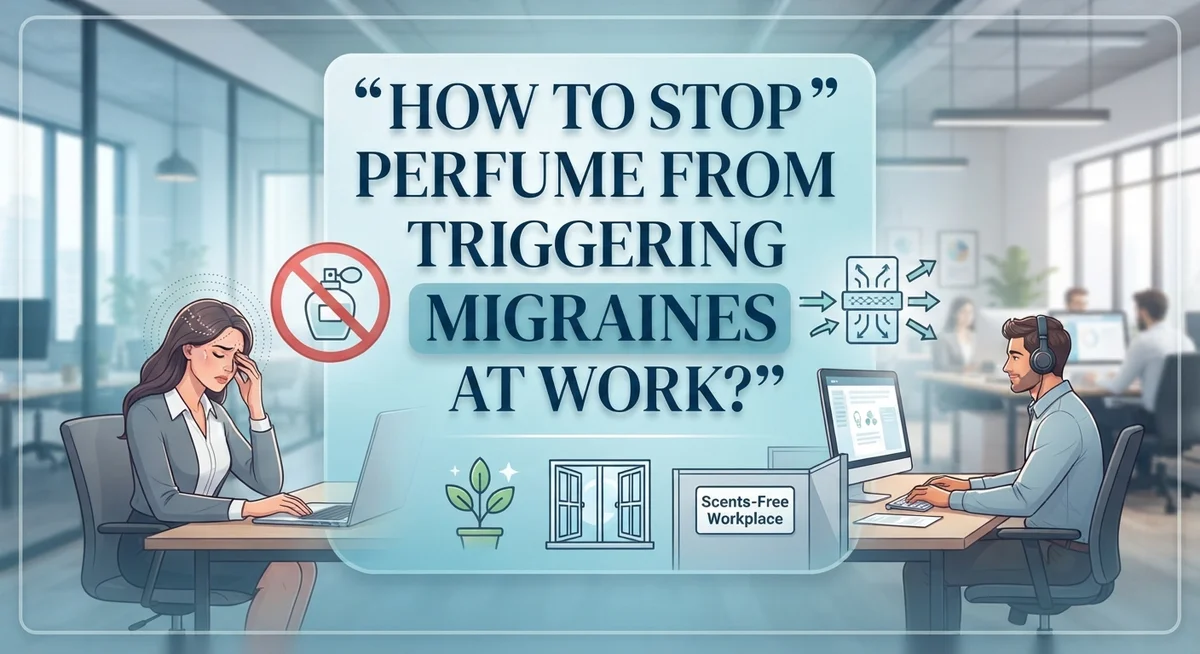
How to Stop Perfume from Triggering Migraines at Work?
Does your coworker’s perfume send you straight into a throbbing headache? You are not alone. Many people deal with sudden migraines caused by strong scents at work.
Synthetic fragrances release volatile organic compounds, or VOCs. These compounds trigger intense reactions in sensitive individuals. A quick spray of perfume can turn your workday into a struggle.
The good news is you can take control. Simple changes to your environment help reduce your exposure. Small steps also protect you when a trigger catches you off guard.
This article covers practical ways to stop perfume from ruining your day. You will learn how to set up a fragrance free space around your desk. We also cover quick fixes for immediate relief when a migraine starts.
By the end, you will have a clear plan. This plan helps you feel better and stay focused at work, even in a scent-heavy office.
In a Nutshell
- Ask for a fragrance free zone. Talk to your manager about a workplace policy. This stops the problem at its source.
- Boost airflow around you. Open a window or sit near a vent. Fresh air pushes scent particles away fast.
- Try an air purifier. A small unit at your desk can filter out floating fragrance molecules all day.
- Keep nose plugs handy. Flesh colored plugs block scent without anyone noticing.
- Use calming oils. A dab of menthol or lavender under your nose can ease the shock of a strong smell.
- Wear a fragrance free button. This simple signal tells coworkers to skip the cologne around you.
- Act fast if exposed. Step outside, rest in a dark room, and drink water right away.
Why Perfume Triggers Migraines: The Science Explained
Perfume triggers migraines through a specific chemical process in your body. When someone wears fragrance, it releases tiny particles called volatile organic compounds, or VOCs. These invisible chemicals float through the air and enter your nose and lungs.
Your brain reacts strongly to these VOCs. The smell signals travel to your nervous system and can activate pain pathways. For people prone to migraines, this activation is intense and immediate. Your blood vessels may constrict and then dilate rapidly. This sudden change causes the throbbing pain you feel.
Sensitivity varies from person to person. Some people experience migraines from light floral scents. Others react only to heavy, musky fragrances. Your individual brain chemistry determines how severe your response becomes.
Synthetic fragrances are particularly problematic. They contain more chemical compounds than natural scents. Each compound adds to the total VOC load in your workspace. The more chemicals present, the higher your migraine risk becomes.
Stress and hormones amplify your sensitivity. On days when you feel tired or anxious, perfume affects you more. Your body’s defenses are already weakened, so fragrance hits harder.
The key insight is that avoidance works better than treatment. Waiting for a migraine to start and then treating it is exhausting. Preventing exposure in the first place protects your health and productivity.
Your workplace air quality matters too. Poor ventilation traps fragrance molecules indoors. These particles concentrate over time, making the problem worse. Fresh air circulation helps, but only if fragrance sources are limited.
Understanding this science empowers you. You now know why perfume affects you differently than others. This knowledge helps you explain your needs to coworkers and managers. It also helps you choose the right prevention strategy for your situation.
Advocating for a Fragrance-Free Workplace Policy
Advocating for a fragrance free workplace policy is your most powerful tool. This approach removes the problem at its source rather than managing symptoms after exposure occurs.
Start by documenting your migraine episodes. Write down when headaches happen, what fragrances triggered them, and how long recovery takes. This data gives your request credibility. Share specific examples with your manager or HR department. Explain that fragrance sensitivity is a legitimate health concern, not a personal preference.
Frame your request around productivity and inclusivity. Migraines cost your company lost work time and reduced focus. A fragrance free policy protects multiple employees, not just you. Many coworkers likely experience similar issues but haven’t spoken up.
Propose clear policy language. The best policies state that employees should avoid wearing fragrances or scented products like colognes, perfumes, and heavily scented laundry items. They should also cover scented candles, air fresheners, and cleaning supplies in shared spaces.
Suggest a gradual rollout if immediate change feels too drastic. Your workplace could start with a fragrance free zone in your department or office area. This shows the policy works without disrupting everyone at once.
Connect with other affected coworkers. When multiple people request the same policy, management takes it more seriously. You might discover colleagues with asthma, allergies, or chemical sensitivities who also benefit.
Provide resources to your employer. Many organizations have successfully implemented fragrance free policies. Sharing examples from similar companies demonstrates feasibility.
Be respectful in your approach. Frame this as a health accommodation, similar to requests for wheelchair accessibility or nut free break rooms. Most managers want to support employee wellness when they understand the impact.
If your workplace resists, explore formal accommodation requests through HR. Many jurisdictions recognize fragrance sensitivity as a valid workplace accommodation. Your persistence protects your health and helps future employees too.
Practical Prevention Strategies at Your Desk
Your desk is your migraine defense zone. Start by creating a physical barrier between you and airborne fragrance particles. Position your workspace strategically near windows, doors, or air vents where fresh air naturally circulates.
Layer your protection methods to maximize effectiveness. Combine ventilation with an air purifier running throughout your workday. This two pronged approach catches fragrance molecules before they reach your breathing space. Keep the purifier on your desk or nearby for best results.
Personal protective items work quietly without drawing attention. Flesh colored nose plugs sit discreetly in your nostrils and block scent molecules before they trigger your nervous system. You can insert them before coworkers arrive and remove them during breaks. This simple barrier prevents the initial exposure that sparks migraines.
Create a scent safe zone around your immediate work area. This means asking nearby coworkers to avoid wearing perfume, cologne, or heavily scented products within a few feet of your desk. Most people respect this boundary once they understand it prevents a medical condition.
Keep your workspace clean and free of scent traps. Fabrics absorb fragrances and release them slowly throughout the day. Wash your desk chair regularly and avoid fabric storage boxes. Opt for plastic or glass containers instead.
Stay hydrated at your desk. Drinking water helps your body process any fragrance exposure you do encounter. Dehydration makes migraines worse, so consistent water intake supports your overall prevention strategy.
Document what works for you specifically. Track which prevention methods reduce your migraine frequency. Some people find that nose plugs alone solve the problem. Others need the combination of ventilation, purifiers, and personal barriers. Your unique sensitivity level determines your ideal protection combination.
What to Do When a Migraine Strikes: Immediate Response Steps
When a migraine strikes at work, you need to act fast. Your immediate response can make the difference between a mild headache and a full day of suffering.
Step one: Leave the scent source immediately. Move away from the person wearing perfume or the area where you smell the fragrance. Go outside if possible. Fresh air helps your body process the volatile organic compounds triggering your migraine. Even a few minutes outside can reduce symptom severity.
Find a dark, quiet space. Light and noise intensify migraines. Ask your manager if you can use a break room, empty office, or quiet corner. Close your eyes and sit still. This resting period gives your nervous system a chance to calm down.
Cleanse your exposed skin and hair. Wash your face, neck, and hands with unscented soap. If the fragrance settled in your hair, rinse it with water. This removes lingering scent particles that keep triggering your symptoms.
Drink water immediately. Dehydration worsens migraines. Keep a water bottle at your desk and sip slowly. Staying hydrated before exposure also builds your migraine resistance.
Consider over the counter pain relief if you need it. Take it early, before the migraine becomes severe. Follow the package directions carefully.
Apply a cool compress to your forehead or neck. Cold temperatures help some people find relief. Use a damp cloth or ice pack wrapped in fabric.
If your migraine doesn’t improve within an hour, contact your doctor. Severe migraines sometimes need prescription medication. Keep your doctor’s number handy.
Document when migraines happen and what triggered them. This record helps you identify patterns and shows your employer the impact of workplace fragrances. Your documentation becomes powerful evidence if you need to request formal accommodations later.
Supplements and Medications That May Offer Support
When perfume triggers your migraines at work, certain supplements and medications may help reduce how often attacks happen or make them less severe. Vitamin B2, also called riboflavin, shows promise for some migraine sufferers. This vitamin helps your brain cells produce energy more efficiently. Some people notice fewer migraines when they take B2 regularly, though results vary from person to person.
Before starting any supplement, talk to your doctor first. They can check if you have any deficiencies and suggest the right dose for you. Your doctor will also make sure supplements don’t interact with other medications you take.
Antihistamines may help if you suspect allergies play a role in your migraine response. Perfume chemicals can trigger histamine release in sensitive people. Taking an antihistamine before you know you’ll be around fragrance might prevent some attacks. Again, ask your doctor before trying this approach.
Magnesium is another supplement worth discussing with your healthcare provider. Some research suggests it may help reduce migraine frequency in certain people. However, it’s not a guaranteed fix.
Here’s what matters most: supplements and medications work best as part of your complete strategy, not as your only solution. They cannot replace avoidance and prevention methods. Think of them as backup support, not your main defense.
Keep a simple log of what you take and how you feel. Write down when migraines happen and what you were doing. This helps your doctor understand what’s actually working for you.
Never rely solely on medication to handle perfume exposure at work. Your real power comes from preventing the exposure in the first place. Medications and supplements are tools that support your efforts, but they cannot eliminate the core problem: the fragrance itself.
Common Mistakes That Undermine Your Prevention Efforts
Many people make critical mistakes when trying to prevent perfume triggered migraines at work. Understanding these errors helps you build a stronger defense strategy.
The biggest mistake is relying only on masking strategies instead of elimination. You might use air fresheners, scented candles, or strong essential oils to cover up perfume smells. This approach backfires. You end up with multiple fragrances competing in the air, which actually triggers more migraines. Masking never removes the volatile organic compounds that cause your pain.
Another common error is assuming your coworkers understand the severity of your situation. You mention perfume bothers you, but they don’t realize it causes debilitating migraines. They continue wearing their usual fragrances. Be specific about your health need. Frame this as a medical accommodation, similar to requests for accessible parking or quiet workspace.
Many people also neglect to communicate their trigger scents clearly. Not all fragrances affect you equally. Powdery scents, tobacco fragrances, and cleaning product smells often trigger migraines more than others. When you tell coworkers your specific triggers, they can make better choices.
Inconsistent prevention efforts create another problem. You might open windows on Monday but forget on Tuesday. You wear your indicator button sometimes but not always. Your body needs consistent protection. Small lapses allow migraine triggers to accumulate.
People also wait too long to address the problem. They endure weeks of pain before requesting formal accommodations through HR. Early action prevents unnecessary suffering and documents your needs.
Finally, many folks overlook their own fragrance use. You might wear fragrance free products but use scented hair products or lotions. These contribute to the scent load in your workspace. Check every personal product you use daily.
Success requires eliminating triggers at the source, not masking them. Combined with clear communication and consistent effort, you create real migraine relief at work.
Troubleshooting Persistent Exposure Despite Precautions
When you’ve taken precautions but still experience migraines from perfume at work, the problem usually runs deeper than your initial strategy. You need to dig into what’s actually happening and adjust your approach.
The first issue to investigate is air circulation. Many workplaces have poor ventilation systems that trap fragrance particles. Even if you sit near a window, recirculated air from coworkers’ desks can carry scent directly to you. Check if your air vents actually pull fresh air in or just recycle stale air. If circulation is the culprit, request to relocate your workspace or ask about upgrading the ventilation system.
Another common problem is that your coworkers don’t fully understand your sensitivity. They may think you’re being dramatic or assume one day without perfume is enough. Have a direct conversation explaining that fragrance molecules persist on clothing, skin, and hair throughout the day. Show them you’re serious by explaining how migraines affect your work performance and health.
Persistent exposure often means your workplace fragrance policy isn’t strong enough. A suggestion to avoid perfume is weaker than an actual policy. Push for a formal fragrance free workplace rule that applies to everyone equally. This removes the burden from you to manage others’ choices.
You might also be experiencing delayed reactions. Fragrance can linger in your workspace from the previous day. Clean your desk, chair, and keyboard regularly with unscented products. Wash your work clothes separately from other items.
Finally, consider that multiple fragrance sources are combining to trigger your migraines. One person’s perfume alone might not cause problems, but perfume plus scented laundry detergent plus air freshener creates a toxic mix. Track exactly when migraines start and what scents are present. This data helps you identify whether elimination or additional ventilation is your real solution.
Final Thoughts
Perfume triggered migraines at work don’t have to control your life. You now have a clear roadmap to follow.
Prevention works best when you combine several strategies together. Ask for a fragrance free policy. Sit near good air flow. Use an air purifier at your desk.
These steps reduce your exposure before problems start. They tackle the root cause instead of just covering it up.
Quick action matters when exposure happens anyway. Move to fresh air right away. Rest in a dark, quiet space. Clean your skin and hair if needed.
Your body needs time to recover after contact with triggering scents. Don’t push through the discomfort and hope it passes on its own.
Pay attention to patterns in your migraines. Notice which scents affect you most. Track how long symptoms last after exposure.
This information helps you explain your needs clearly to coworkers and supervisors. It also helps your doctor understand your specific triggers.
Your health comes first in any workplace situation. You have every right to ask for reasonable changes. Most colleagues want to help once they understand your struggle.
Building a fragrance free environment takes patience and consistent effort. Small changes add up over time to create real protection.
Don’t feel discouraged if your first attempts don’t work perfectly. Adjust your approach based on what you learn along the way.
Some solutions work immediately. Others need fine tuning over several weeks.
Stay persistent with your prevention plan. Combine ventilation, policy requests, and personal protection methods together.
Your workplace can become migraine friendly with the right steps. Trust the process and keep advocating for the fresh air you need to feel your best every day.
Frequently Asked Questions
Why do certain perfumes trigger migraines more than others?
Different fragrances release different volatile organic compounds (VOCs) into the air. Your brain may react strongly to specific scent molecules. Synthetic fragrances tend to trigger migraines more often than natural ones. Tobacco, powdery, and liquor based scents cause problems for many people. Cleaning product and laundry fragrances also rank high as migraine triggers.
Your personal sensitivity matters too. What bothers one person may not affect another. You might notice that floral scents bother you while fruity ones don’t. Tracking which specific fragrances cause your migraines helps you communicate your needs clearly.
Can I use essential oils to prevent perfume triggered migraines?
Certain essential oils may help reduce migraine severity. Menthol and lavender oils show promise for some people. However, they work best as part of a larger prevention plan, not as your only strategy.
Apply soothing oils to your skin or use a diffuser in your personal space. Start with small amounts to see how your body responds. Some people find relief while others don’t. Essential oils aren’t a replacement for eliminating fragrance exposure at work.
What should I do immediately when exposed to triggering perfume?
Move to fresh air right away. This is your first and most important step. Leave the area where the scent is strongest.
Find a dark, quiet room to rest. Close your eyes and breathe slowly. Cleanse any exposed skin and hair with fragrance free soap. Drink plenty of water to help your body flush out the trigger. Over the counter pain relief may help, but consult your doctor first about what’s safe for you.
Should I take supplements to prevent migraines at work?
Some research suggests vitamin B2 (riboflavin) may help certain migraine sufferers. Talk with your doctor before starting any supplement routine. What works for one person rarely works for everyone.
Supplements work best alongside other prevention methods like ventilation and fragrance avoidance. Never rely on supplements alone to solve your workplace migraine problem.

Hi, I’m Lily! I started this blog to share honest reviews, real comparisons, and helpful guides so you can find your perfect scent without the guesswork. Welcome to my scented world!